
The Escape
There is a specific hour in Pench when the forest stops performing and simply exists.
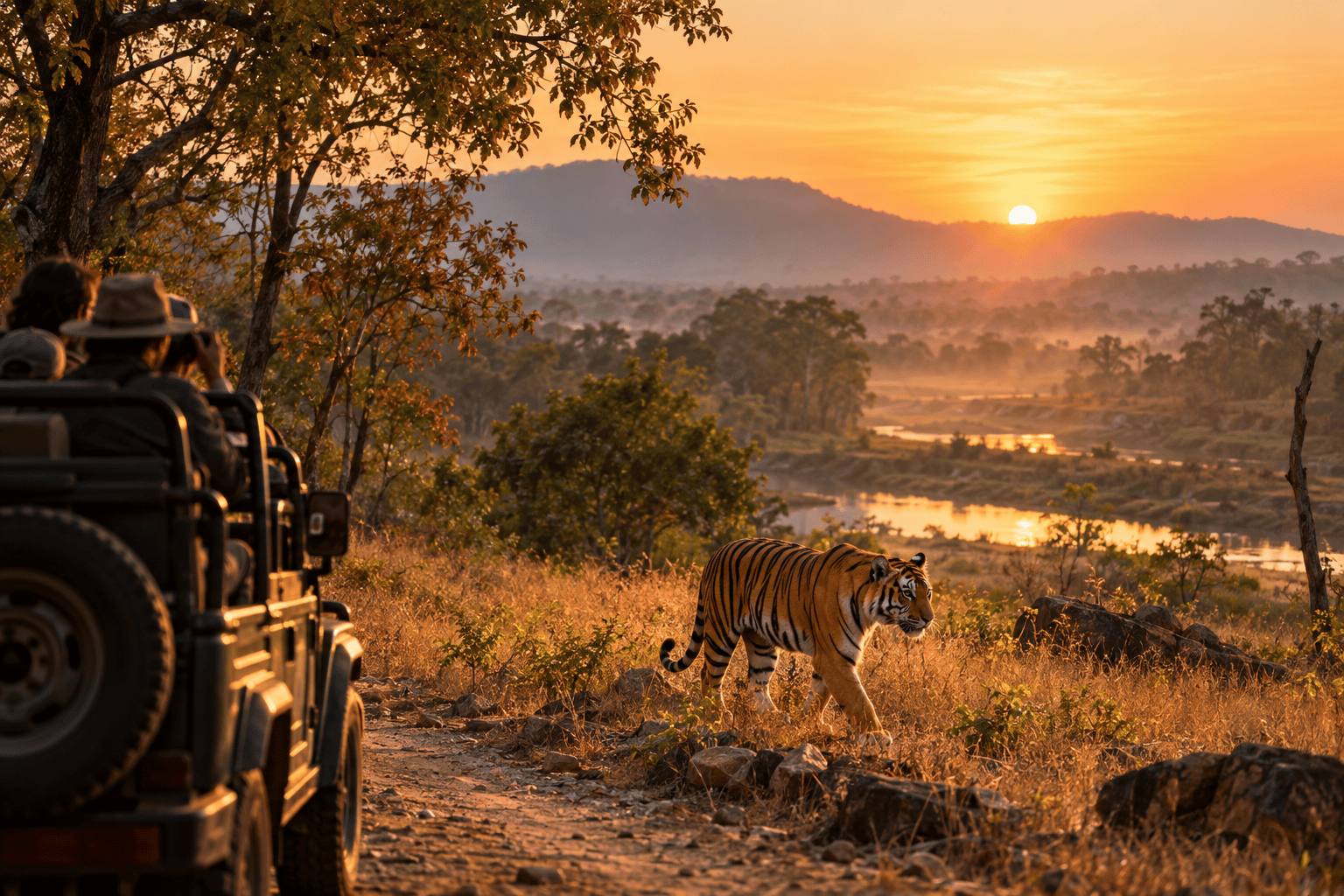
It arrives around 5:40 in the morning, before the light does. You are in an open Gypsy, wrapped in a blanket that smells faintly of woodsmoke, and the teak canopy above you is still a silhouette rather than a colour. Nobody speaks. The engine has been cut. Somewhere to the left, a sambar deer releases a single, ringing alarm call — and every person in that vehicle forgets, completely and involuntarily, that they have an inbox.
That is the thing no one tells you about a serious safari. The disconnection is not something you schedule. It is taken from you.
Most of us have grown fluent at performing rest. We book the villa with the infinity pool, we announce the digital detox, and we check the phone under the table between courses. The forest does not permit that negotiation. There is no signal in the core zones, no polite way to step away, and no version of the morning where the tiger waits for you to finish a call. You surrender the whole thing or you get nothing at all.
And Pench, more than almost anywhere in Central India, rewards that surrender.
Spread across Madhya Pradesh and Maharashtra, Pench Tiger Reserve is the landscape widely believed to have shaped Rudyard Kipling's The Jungle Book. That heritage is not a marketing line stapled on afterwards. It is genuinely legible in the terrain — the Seeonee hills of the stories are these hills, the wolf country is this country, and the river that threads the reserve is the same Pench that still draws animals down to drink every evening of the dry season.
Knowing that does something to the experience. You are not simply watching wildlife. You are moving through the original text.
What makes Pench unusual among India's marquee reserves is its restraint. It has never chased the crowds the way some parks have. The vehicle density is lower, the gates are calmer, and a sighting here rarely comes with the scrum of twenty jeeps jockeying for position. For travellers who have already done the famous circuits and come home vaguely disappointed by the queueing, that difference is the entire point.
This is a guide for planning that kind of trip properly — an unhurried, privately paced expedition through Pench, built around the right gate, the right season and the right camp, rather than whatever the booking portal happened to have left.
The Landscape, and What Moves Through It
Pench does not look like the jungle of the imagination. There is no dripping green wall, no claustrophobia.
Instead you get teak — tall, straight, silver-barked, spaced like a cathedral colonnade — opening onto wide golden grasslands the locals call maidans. Sightlines run long here. You can watch a herd of chital drift across open ground four hundred metres away and see, in the set of their heads, the precise moment they register something you cannot.
That openness is why photographers quietly prefer Pench. The light gets in. A tiger crossing a maidan at seven in the morning is lit from the side in a way that the denser reserves simply cannot offer.
But the real story of this forest is written in its prey.
Pench carries an exceptional density of herbivores — chital in the hundreds, sambar, nilgai, wild boar, and the vast, slate-grey gaur that emerge from the treeline like something geological. Prey density is the number that matters, because predators do not distribute themselves according to beauty. They distribute themselves according to food. A forest that feeds this many deer supports a genuinely healthy population of tigers, and it supports them at territory sizes tight enough that your odds on any given drive are meaningfully good.
The leopards are the connoisseur's prize. They are here in numbers, and they are difficult — draped along a branch at dusk, or crossing a fire line with that low, poured-liquid gait, gone before your lens finds focus. Spotting one feels less like luck and more like being let in on something.
Then there are the dholes.
Indian wild dogs hunt in packs of a dozen or more, and watching them work is the single most electrifying thing this forest offers. They do not stalk. They commit. The pack fans out, the pursuit opens up across the grassland in total silence apart from the drumming of hooves, and the whole scene resolves in ninety seconds. People who have seen a dhole hunt tend to talk about it more than they talk about their tigers.
Above all of it: more than three hundred bird species. Indian rollers detonating into blue mid-flight. Racket-tailed drongos mimicking alarm calls with what can only be described as mischief. Malabar pied hornbills crossing the river at height.
A good naturalist reads all of this as one connected text. The langur barking from the canopy, the peacock's sudden scream, the way a herd of chital rotates to face a single direction — these are not atmosphere. They are information, and a guide who can interpret them is the difference between a drive and an expedition. Which is precisely why the quality of your safari in Pench rests far more on who is sitting beside you than on which gate you entered.
The Exclusive Enclaves
Where you sleep in Pench is not a footnote to the safari. It is roughly half of it.
You will spend perhaps six hours a day inside the park. The remaining eighteen are spent somewhere — and the gap between a competent hotel and a properly conceived wilderness camp is the gap between a holiday you enjoyed and one you talk about for a decade.
The defining properties here have understood something that the wider luxury industry often misses: in a forest, opulence is not the point. Space is. Silence is. The ability to sit alone on your own verandah at four in the afternoon, hearing nothing engineered, is worth more than marble.
Baghvan, by Taj Safaris, is the reference point. Twelve suites, each freestanding, each with a rooftop machan — an open-air sleeping deck where you can have your bed made up under the stars and fall asleep listening to the forest conduct its night business. It is the detail everyone remembers. The lodge's naturalist programme is genuinely rigorous rather than decorative, and the whole property is built on the principle that guests should encounter staff and never encounter each other.
Jamtara Wilderness Camp takes a different and equally compelling line. It sits on the quieter northern edge of the reserve, on the banks of the Pench river, and its signature is the Machan dinner — a table laid in the middle of open farmland under the night sky, lanterns marking the perimeter, the meal served slowly while nilgai move somewhere in the dark beyond the light. It is one of the more genuinely romantic things available anywhere in Indian wildlife travel, and it does not feel staged.
Saj in the Forest offers a polished, comfortably appointed base close to the Turia side, and suits travellers who want serious comfort and a shorter transfer without the full expedition-camp aesthetic. Jungle Camp Pench sits in the more relaxed register — well-run, unpretentious, and a sound choice when the priority is time in the park rather than the property itself.
A word on the thing that actually determines your mornings: transfer time to your gate.
A camp forty-five minutes from your entry point means a 4:45 alarm and a cold, jolting drive before the drive. A camp fifteen minutes away means an extra half hour of sleep and a coffee taken sitting down. Over four days that compounds into something you feel physically. It is the single most underrated variable in the entire plan, and the reason the property should be chosen after the gate — never the reverse.
Good Pench safari booking sequences those two decisions in the correct order.
The Strategy: Gates and Timing
Here is where most itineraries are quietly compromised, usually months before anyone arrives.
Pench is entered through a number of gates, and each opens onto a different character of forest. On the Madhya Pradesh side, Turia is the best-known and most heavily subscribed — excellent terrain, strong tiger movement, and consequently the gate whose permits vanish first. Karmajhiri runs quieter and deeper, with a more varied drive. Jamtara sits at the northern end and rewards the patient. Across the border in Maharashtra, Sillari and Chorbahuli offer genuinely good game viewing with noticeably lighter vehicle traffic, and Khursapar has built a serious reputation among people who go often.
The buffer zones deserve their own mention. Teliya has become one of the most productive stretches in the whole reserve in recent years, and buffer permits are both easier to secure and, in the right hands, extremely rewarding. The old assumption that buffer means second-tier no longer holds.
What no one should tell you is that one gate is definitively better. Tigers do not consult the zone map. A gate that produced nothing for three weeks will produce the sighting of someone's life on a Tuesday. What a gate does reliably determine is the texture of your morning — how far you drive, how many vehicles you share the road with, what the terrain looks like in your photographs.
Reading the seasons
The reserve runs from October to June and closes through the monsoon.
Winter, October to February, is the connoisseur's season for comfort. The forest is still carrying green from the rains, the mornings are crisp enough to justify the blanket and the flask, and the migratory birdlife arrives in force. Sightings are steady rather than spectacular, because water is everywhere and animals have no reason to concentrate. What you get instead is a landscape at its most beautiful and a climate that makes two drives a day genuinely pleasant.
Summer, March to June, is the serious wildlife season, and it is not for everyone. The heat is real — April and May can be punishing by midday. But the forest dries out, the natural water sources shrink, and the entire cast of animals is compelled toward a handful of waterholes and the river. Predictability rises sharply. Photographers, and anyone whose primary objective is a tiger, come in summer and accept the discomfort as the price.
The practical constraint underneath all of this: permits are released roughly 120 days ahead through the Forest Department portal, and the desirable combinations — a peak-season weekend at Turia, a long weekend at Khursapar — are gone almost immediately. A pench jungle safari planned six weeks out is a pench jungle safari planned around whatever nobody else wanted.
Four months of lead time is not excessive here. It is simply the standard.
The Art of the Itinerary
The most common mistake in wildlife travel is treating a safari like a transaction. Book the drives, tick the tiger, fly home.
It rarely works. Travellers who arrive with a checklist spend the whole trip in a state of low-grade anxiety about whether they are going to get something — which is, incidentally, the surest way to miss what is actually in front of them.
There is no correct length for a Pench safari, and anyone who tells you otherwise is describing their own inventory rather than your trip. What matters far more than the number of nights is the rhythm you settle into once you are there — and whether the itinerary was built around you or around a template.
The shape of a day
It begins in the dark. Coffee taken standing, a blanket over the knees, through the gate the moment it opens — because the first ninety minutes are disproportionately productive. The night's activity is still written in the dust, and a good tracker reads pugmarks the way the rest of us read a page.
Mid-morning brings a proper breakfast at a designated halt: parathas, boiled eggs, fruit, more coffee, eaten standing beside the Gypsy while a troop of langur audits you from the trees.
Then the forest goes quiet, and so should you. The middle of the day belongs to the camp — sleep, a swim, an hour on the verandah doing nothing at all. Travellers who try to fight this are exhausted by the third morning.
The afternoon drive rolls out around three and runs until the gate closes. That last stretch — long amber light dropping in bars through the teak, dust hanging in it — is when this forest is at its most beautiful, and it is the reason the afternoon is never the lesser drive.
What the night adds
The buffer zones permit something the core cannot: a night safari.
Under a spotlight the forest reassembles itself entirely. Civets. Nightjars lifting off the track in the beam. Hares, a flying squirrel arcing between trees, the occasional leopard moving with complete unconcern — and, if the night is generous, eyes at the edge of the light that belong to something larger.
It is a genuinely different reserve after dark, and it belongs in any serious itinerary.
Built around you
Beyond the daily rhythm, everything else is a decision rather than a default.
How many gates you work, and whether you stay loyal to one zone or move between them for different terrain and a different resident tiger family. Whether your drives are weighted toward photography — which changes where you position and how long you are willing to sit. Whether the trip is a standalone escape or one movement in a longer Central India circuit. Whether you want the camp at the centre of the experience or treated purely as a base.
Those choices are what separate a booking from an expedition, and they cannot be made from a package page.
The forest will do what it does regardless. What can be engineered is everything around it — the gate, the season, the guide, the hours you are inside when the light is good. That is the work, and it is the whole of what we do when we put together a private Pench expedition.
Before You Go
A few things worth holding on to.
Carry the same original government-issued photo ID you used at the time of booking — it is checked at the gate, and a mismatch will cost you the drive. Reach your gate before reporting time; the forest does not hold the door. Stay in the vehicle, keep your voice down, and let the guide make the calls about how close is close enough.
And accept the premise. Nothing is guaranteed. These are wild animals moving across a vast reserve entirely on their own business, and any operator who promises you a tiger is either inexperienced or selling something.
What careful planning buys you is not certainty. It is odds — and the odds are largely set four months out, in a handful of unglamorous decisions made long before anyone packs a bag.
0 comments for this post