
The Escape
The cold arrives before the light does.
You are in an open Gypsy at twenty past five, hands around a steel cup, and the air moving over the windscreen has a bite to it that the middle of the day will erase entirely. The track ahead is pale. Sal trunks stand in ranks on either side, dark and straight, and somewhere in them a jungle owlet is still calling.
Then the forest opens, and you are looking at a meadow the size of a small town, filling with mist.
Nobody in the vehicle says anything. There is nothing to say, and more usefully, nothing to check. Your phone has no signal and will not find one for the next three hours. That fact, which would irritate you anywhere else, turns out to be the point.
What Kanha offers a certain kind of traveller is not scenery. It is uninterrupted attention.
Most of us have not held a single thread of thought for three unbroken hours in years. We have trained ourselves out of it. And the forest, indifferent to all of this, simply proceeds at its own pace until you fall into step with it, which usually happens somewhere in the second morning, without your noticing.
A safari in Kanha rewards that surrender more than it rewards ambition. The people who arrive determined to see a tiger by Tuesday tend to have a worse time than the ones who arrive prepared to watch whatever the forest is doing. Both may see a tiger. Only one of them will remember the barasingha stag standing chest-deep in mist, or the exact quality of silence that falls across a meadow when something large is moving through the treeline.
This is a guide to planning a private safari in Kanha properly: the gate, the season, the camp, and the unhurried shape of the days in between.
Reading the Forest
Kanha is built on a rhythm of closure and release.
You spend twenty minutes inside sal forest, the canopy tight overhead, visibility reduced to whatever the track allows. Bamboo crowds the edges. The Gypsy moves over dry leaves with a sound like paper tearing. And then the trees simply stop, and a meadow runs out in front of you for a kilometre, ringed by forest, with a herd of chital grazing at the far end.
These open grasslands are what set Kanha apart from most Indian reserves. They give the eye somewhere to go.
They also give you a chance at the animal that matters most here. The hard-ground barasingha is found in Kanha and effectively nowhere else, and its survival is the reserve's defining conservation achievement. It was reduced to a remnant population within living memory and brought back through decades of habitat protection and careful management. A mature stag in these meadows, antlers heavy, is a more meaningful sighting than most people realise when they see one.
The rest of the cast is substantial. Chital in numbers, sambar moving through heavier cover, gaur emerging from the treeline with that unhurried bulk, wild boar, langurs overhead. Dhole hunt here in packs, and watching them work is among the most electrifying things this forest offers. Leopards are present and difficult, which is rather the point of them. Birdlife runs into the hundreds of species.
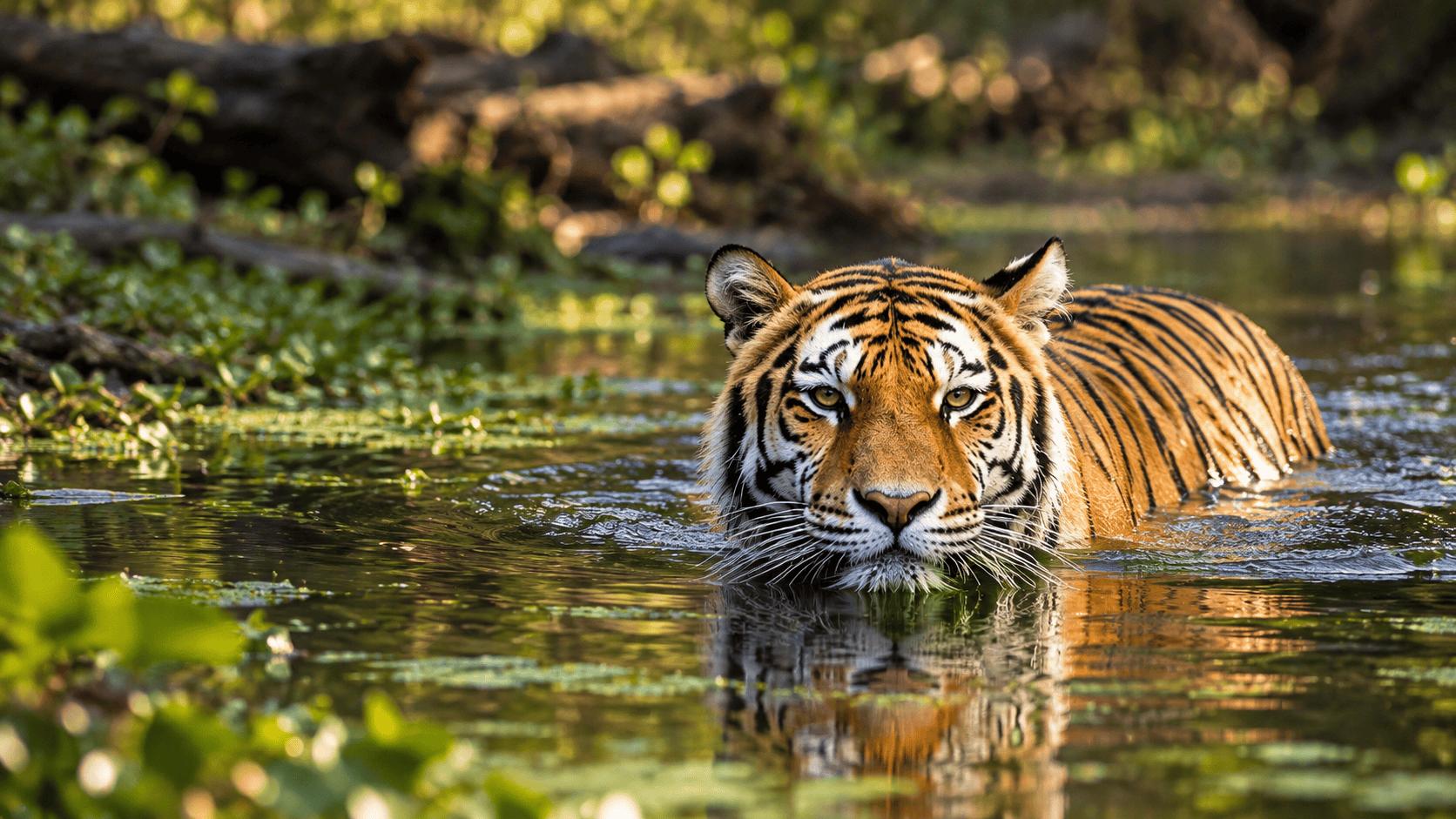
And the tigers move through all of it, mostly unseen.
This is where a good naturalist earns their place in the vehicle. They are not scanning for stripes. They are listening. A chital alarm call, sharp and repeated, means something is moving and the deer can see it. A sambar's single deep bell carries further and usually means more. Langurs calling from height give a direction. A peacock's scream is often nothing at all.
Then there is the silence that is not ordinary silence, when the birds stop and the meadow tenses, and everyone in the vehicle sits up without being told. It rarely resolves into anything. Sometimes it does.
Understanding the forest, rather than hunting through it, is what separates a good Kanha wildlife safari from three hours of driving.
Where You Sleep, and Why It Decides Your Mornings
You will spend perhaps six hours a day inside the park. The other eighteen are spent somewhere, and that somewhere shapes the trip more than most people expect.
Start with the unglamorous variable: how far your camp sits from the gate you are booked into.
A property an hour from your entry point means a pre-dawn alarm and a cold road transfer before the drive even begins. Fifteen minutes away means another half hour of sleep and a coffee taken sitting down. Across four mornings that difference is physical. It is the reason accommodation should be chosen after the gate, not before, and the reason a camp that photographs beautifully can still be the wrong answer.
What the better properties around Kanha share is an understanding that in a forest, space and quiet matter more than finish.
Banjaar Tola sits on the Banjaar river on the Mukki side, tented and deliberately light on the land, with the water and the forest beyond it doing most of the work. Shergarh is small and personally run, the sort of place where the pace of the day is set by conversation rather than a schedule, and which suits travellers who want to feel like guests rather than occupants.
Saccharum Lodge and Jungle Lodge Shankala offer comfortable, well-positioned bases for travellers who would rather weight the budget toward drives and naturalists than toward the room. Jungle Camp Kanha sits in a similar register: straightforward, unfussy, close to the forest.
The question worth asking is not which is finest. It is what you want the middle of your day to feel like.
If you intend to do two drives daily for four days, the hours between them are not filler. They are recovery. A property with somewhere genuinely quiet to sit through the heat, and staff who understand that a guest reading alone is not a guest to be attended to, will do more for the expedition than any amount of specification.
Gates, Seasons and the Case for Planning Early
Kanha is large, and the gate you enter through sets the shape of your morning before you have seen anything.
Khatia is the principal entry on the western side and the busiest of the gates, convenient to a cluster of accommodation and well suited to travellers who want short transfers. Kisli lies immediately beyond it, opening into the western forest and its meadow systems. Mukki, on the southern side, sits in a quieter part of the reserve and suits travellers based at that end, with a different character of drive. Khapa is a buffer entry, and buffer permits are generally easier to secure than core ones.
No gate is universally better, and anyone who tells you otherwise is describing their own logistics. Tigers do not consult the zone map, and a stretch of forest that produced nothing for a fortnight will produce something extraordinary on a Thursday.
What a gate reliably determines is the texture of the drive: how far you travel, what terrain you photograph, how many vehicles share the road with you, and how early the alarm goes.
Winter against summer
The core zones operate from roughly October to June and close through the monsoon.
The cooler months are the comfortable season. Mist sits in the meadows at first light, the air has an edge that makes a blanket and a flask feel earned, and the softer light suits the landscape. Water is widely available, so animals disperse and sightings are steadier rather than concentrated. Birdlife is at its strongest.
The hot months work differently. The forest dries, water sources contract, and the wildlife is drawn toward what remains. Early mornings and late afternoons carry most of the activity, and the middle of the day becomes genuinely demanding. Photographers accept the heat because of what the concentration does to their odds.
Neither season guarantees anything. They simply fail in different ways.
The practical constraint sits underneath all of it. Permits are issued through the Madhya Pradesh Forest Department's MP Online portal, with the advance quota released well ahead of travel and desirable zone-and-date combinations going quickly. The release schedule is adjusted from season to season, so it is worth checking the portal rather than assuming a fixed window. Either way, a carefully curated Kanha expedition is assembled months out, not weeks.
The Shape of the Days
There is no correct number of nights, and anyone who prescribes one is describing their own inventory. But something does change around the third or fourth morning, and it is worth building the trip to reach it.
What changes is that you stop counting.
The first drive is always slightly anxious. You want something to happen. By the fourth, you have watched enough of the forest's ordinary business that you are no longer auditing the morning for results, and that is precisely when you start seeing properly.
A day has its own architecture.
It begins in the dark with coffee taken standing, and a short transfer to the gate to be there when it opens. The first stretch is the quiet one. Nobody talks much. The night's movement is still legible in the dust, and a tracker reads it the way the rest of us read a page.
Then the forest wakes in layers. Birds first, then the deer shifting out into the meadows, then whatever the guide's attention is being pulled toward that you have not noticed yet.
Breakfast comes at a halt inside the park or back at camp, depending on the day. After that, the middle hours belong to the property. Sleep, a swim, an hour doing nothing in the heat. Travellers who fight this are exhausted by the third morning and cannot work out why.
The afternoon drive runs out until the gate closes, and the last forty minutes are often the best of it, when the light drops low through the sal and dust hangs behind the vehicle in the gold.
Dinner is where the day gets assembled. A good naturalist will tell you what you actually saw, which is frequently more than you registered at the time, and what it suggests about where to go tomorrow.
Then an early night, because it starts again before five.
Several drives beat one long one for a simple reason: the forest is different every time you enter it. Wind, temperature, what moved through overnight, which waterholes are holding. A private safari in Kanha built over several days gives you the range of conditions rather than a single sample of them.
Before You Go
A few things that are worth getting right.
Carry the original government-issued photo ID whose details were entered at the time of booking. It is checked at the gate, the permit is issued against that name and number, and a mismatch is not something anyone can negotiate away at six in the morning. Permits are date, shift and zone specific, and they are not transferable.
Reach your gate ahead of reporting time. The forest does not hold the door.
Dress in neutrals and dress in layers. Winter mornings in an open vehicle are considerably colder than the forecast suggests, and by eleven you will have shed most of it. Closed shoes, something over the face for dust, a hat for the afternoon.
Binoculars matter more than most first-time visitors believe, and one pair between two people is a false economy. For photography, reach is the constraint: the meadows are wide and the animals are not obliged to come closer.
Inside the park, stay in the vehicle, keep your voice down, and let the guide judge distance. This is not only etiquette. A vehicle that stays quiet sees more, because everything around it stays relaxed.
And accept the premise. Nothing is guaranteed. These are wild animals moving across a very large reserve on their own business, and any operator promising you a tiger is either inexperienced or selling you something. What planning buys is not certainty but position: the right gate, the right hours, the right person beside you.
What You Actually Take Home
On the last morning you will notice something.
You are no longer waiting for anything. The meadow is filling with light, a herd of chital is working its way along the treeline, a roller drops off a branch and turns electric in mid-air, and none of it is building toward a climax. It is simply the forest, doing on this Thursday what it does on every other one.
And you have been watching it, uninterrupted, for the better part of an hour.
That is the thing worth paying for. Not the tented suite, though the suite is good. Not the vehicle or the naturalist or even the possibility, always present and never promised, of a tiger stepping out of the sal onto the road ahead.
It is four or five days in which nothing has asked anything of you. No notifications, no decisions that cannot wait, no fragment of your attention held in reserve for something else. Whatever else the forest gives you, it gives you that, and it is becoming genuinely difficult to buy anywhere.
The barasingha will still be standing in those meadows next season, which is not a small thing to be able to say about an animal that very nearly went.
When you are ready, we will handle the permits, the gates, the camps and the naturalists. You handle the part where you sit very still in an open vehicle at dawn and let the forest get on with its morning around you.
0 comments for this post